


Nestled among rolling hills and sparkling streams in southwestern Sri Lanka lies the Sinharaja Forest Reserve – the country's last remaining lowland rainforest and a window into a long-vanished prehistoric era. This UNESCO World Heritage Site spans nearly 9,000 hectares and is crisscrossed by a dense network of rivers and streams flowing both north and south. The region is among the wettest in the country and supports exceptionally lush vegetation.
A forest teeming with life – Flora and fauna
The vegetation of the Sinharaja Forest Reserve is exceptionally diverse, offering a breathtaking panorama of tropical lushness. In the valleys and on the lower slopes, mighty dipterocarps dominate, their canopies almost completely obscuring the sky and forming the predominant tree family in Southeast Asian rainforests. Among them grow palms, such as Loxococcus rupicola, along with a profusion of ferns, lianas, and orchids that trail, twine, and cling to trunks and branches. Many of these plants are endemic to Sri Lanka, occur in the wild only within this forest.
The wildlife also displays an impressive diversity. Sinharaja is famous for its bird communities, which often travel in mixed flocks – led by the characteristic Sri Lanka Blue-throated Thrush (Cissa ornata). This forest is also the home to colorful butterflies, numerous amphibians and reptiles, as well as rare mammals such as the Purple-faced Langur (Semnopithecus vetulus) and the Sri Lankan leopard (Panthera pardus kotiya) (1, 3).
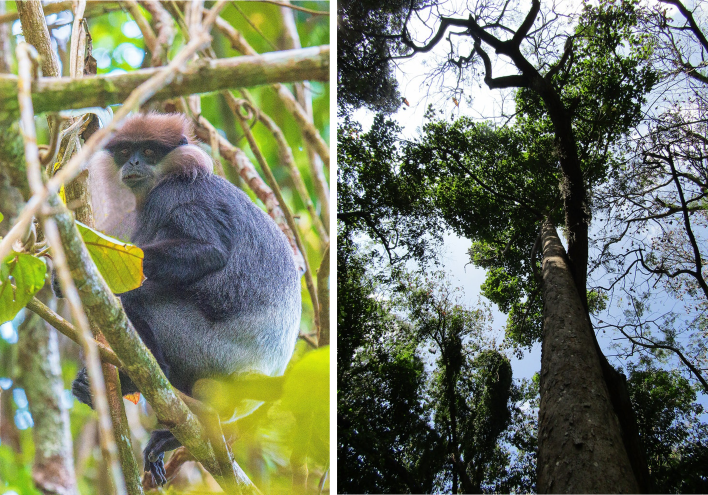
The rare purple-faced langur (left, © Ko Hon Chiu Vincent) and the endemic plant species Dipterocarpus zeylanicus (right, © Leonora Enking).
Humans and rainforests – Use and impact
More than 39 villages, with a combined population of over 5,000, lie along the fringes of the Sinharaja Rainforest. The communities living there are predominantly Kandyan Sinhalese and practice Buddhist. For them, the forest is not only a vital source of livelihood but also holds deep cultural and spiritual significance. In traditional beliefs, acts such as killing animals or felling trees within the forest are regarded as especially serious.
Many households cultivate small plots of land growing tea, rice, or vegetables and harvest products from the rainforest. The kitul palm is particularly important as its sap is processed into palm sugar (jaggery), treacle, and palm wine – a tradition passed down through generations. Rattan for baskets and furniture, as well as cardamom cultivation in the undergrowth, are also economically significant. In addition, slash-and-burn agriculture (chena) is practiced, and village communities gather fruits, medicinal plants, and fibers for their own consumption.
This close connection between humans and the rainforest highlights the diversity of its uses, and why its protection is crucial (1, 2).
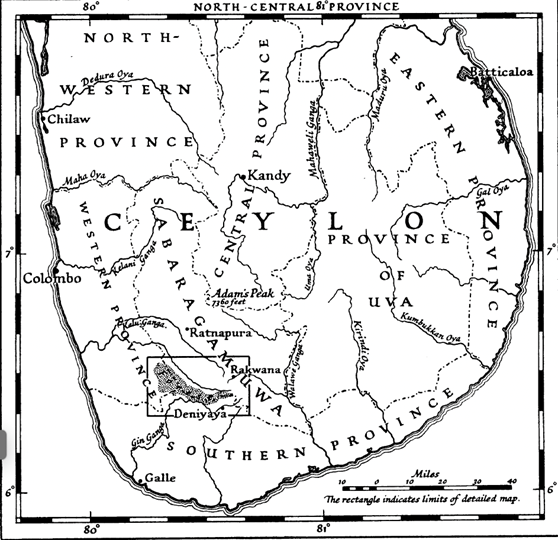
The Sinharaja Rainforest Reserve is located in southwestern Sri Lanka. © https://www.jstor.org/stable/1787913
Threats to the Sinharaja Rainforest
Despite its status as a UNESCO World Heritage Site, the Sinharaja Rainforest faces numerous threats, including deforestation for agriculture and settlements, illegal logging, and gemstone mining. The expansion of roads and other infrastructure also contributes to the fragmentation of the forest. In recent decades, developed areas along the edges of the protected area have increased significantly – not only for residential and commercial uses, but also for tourism-oriented projects, putting additional pressure on this sensitive ecosystem.
Besides, climatic changes also strongly affect Sinharaja. Studies showed increased temperatures at the northern and southern boundaries of the forest, along significant changes in rainfall patterns. While no overall downward trend in rainfall amounts has been reported yet, there are indications of desiccation tendencies in areas with dense vegetation. Such processes can impair forest structure and ecosystem stability in the long term (2, 3).
Protection and management
The Sinharaja Rainforest has enjoyed the highest level of legal protection in Sri Lanka as a National Heritage Wilderness Area since 1988, and large parts of the area were declared a forest reserve as early as 1875. It has also been a UNESCO Biosphere Reserve since 1978 and a World Heritage Site since 1988. The Forest Department, under the supervision of the Ministry of Lands and Land Development, is responsible for its management. Conservation measures are based on detailed management plans that equally consider nature conservation, scientific research, buffer zone management, and the involvement of local communities.
Thanks to its remote, mountainous location, the forest remained largely untouched for a long time. Today, visits are strictly regulated and only possible with a permit in order to preserve the ecological value of this unique natural heritage in the long term (4).
Author: Robert Delilkhan
References
(1) Baker, J. R. (1937). The Sinharaja rain-forest, Ceylon. The Geographical Journal, 89(6), 539–551. https://www.jstor.org/stable/1787913
(2) Daskon, C. D. (2010). Human impacts on rain forests in Sri Lanka: The case of “Sinharaja” forest reserve. Sri Lanka Forester, 31(1–2), 11–30.
(3) Samarasinghe, J. T., Gunathilake, M. B., Makubura, R. K., Arachchi, S. M. A., & Rathnayake, U. (2022). Impact of Climate Change and Variability on Spatiotemporal Variation of Forest Cover; World Heritage Sinharaja Rainforest, Sri Lanka. Forest Science, 6(1). https://doi.org/10.24259/fs.v6i1.18271
(4) UNESCO World Heritage Centre (o. J.). Sinharaja Forest Reserve. Abgerufen am 14. August 2025, von https://whc.unesco.org/en/list/405/