


Professor Sarath Wimalabandara Kotagama, Sri Lanka's first professor of ornithology and a long-time environmental expert, combines scientific work with public consulting, including for government ministries and as head of the Wildlife Department. Since the late 1960s, he has been closely associated with the Sinharaja Rainforest, Sri Lanka's last great remaining rainforest and a UNESCO World Heritage Site. In conversation with GREEN BOOTS, he discusses the unique characteristics of the forest and why data, fieldwork, and collaboration with local communities remain crucial.
Could you briefly describe your background and how you came to work in Sinharaja?
I am an ornithologist by training and became an environmental expert through my work. My involvement in Sinharaja began in 1969 as a student, when a logging operation was planned for a plywood factory. We joined the campaign of the Wildlife and Nature Protection Society under Thilo Hoffmann. The logging was then carried out mechanically from 1972 to 1977 – the first time this had been done in Sri Lanka. This opened up a unique opportunity for research. From 1980 onwards, we established a field station and began systematic studies of the wildlife. This transformed our initially activist work into scientific research that could serve as a basis for conservation decisions.
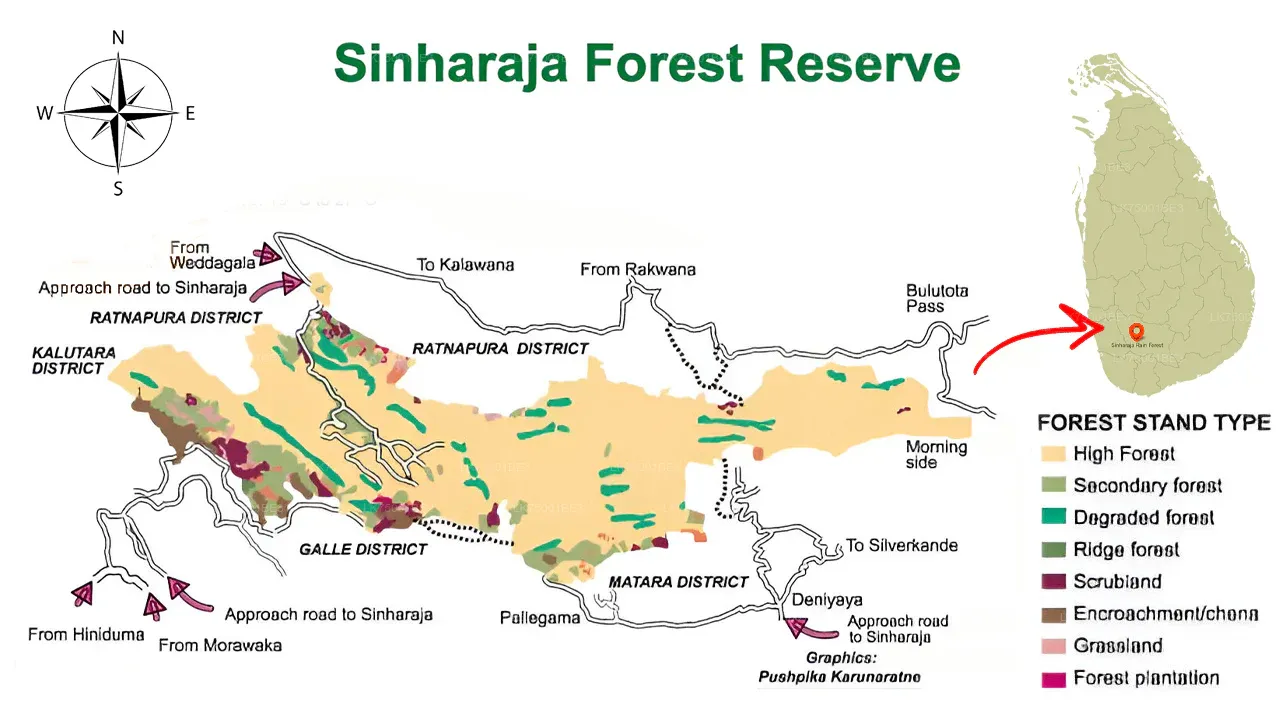
Map of the Sinharaja rainforest showing the different habitat types. © Lakpura
What were your goals in this early research phase?
We had clear objectives. First, we wanted to document the fauna of a Sri Lankan rainforest, as there was no comprehensive baseline data for Sinharaja. We focused on vertebrates and some visible invertebrates. Second, we wanted to investigate the effects of logging, especially on small mammals and birds, by comparing logged versus unlogged areas. These studies showed that endemic small mammals declined in logged areas, while the number of typical "village species" increased. A significant change in bird species composition was also observed.
You have described Sinharaja as a "scientific treasure trove," especially because of its bird communities. What did you discover?
During investigations into logging sequences, we found mixed flock communities in the wet zone of the rainforest. These flocks consist of 20 to 30 species with a total of 60 or 70 individuals and move together through the forest in search of food, at heights of approximately five to over thirty meters. Their constant calling breaks the silence of the forest until an alarm call immediately brings about a quiet.
Two species, the Orange-bellied Babbler and the Crested Drongo, appear to form and hold the flock together. Many species are insectivores, but even primarily fruit-eating endemic species like the Layard's Parrot or the Yellow-fronted Barbet join in. This would be a worthwhile area for further investigation. We also observe species that temporarily join, such as the blue magpie or the Spot-winged Thrush, which briefly leave their territories when the flock passes. A Lanyard's Squirrel often follows at the rear of the flock, taking advantage of food made accessible by woodpeckers.
The flocks occur year-round, but their size and composition change during the breeding season. In the drier phase, which is the main breeding season for the wetland area, the number of dominant Babblers decreases and the flock areas become smaller. Migratory birds such as the Paradise Flycatcher may join them. We now plan to conduct further research using modern tracking technology on minimum land use to understand how far flocks cross forest boundaries. According to current findings, this is only a few hundred meters, provided there is no forest connection.
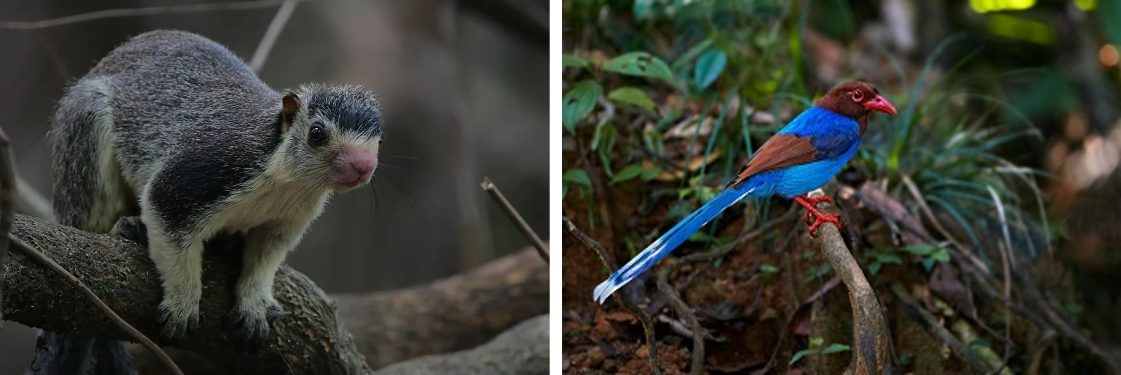
The Sinharaja Rainforest is home to a high number of endemic species (i.e., animal and plant species that are found nowhere else). Examples include the Sri Lankan giant squirrel (Ratufa macroura, left) and the blue magpie (Urocissa ornata, right), a bird species endemic to Sri Lanka and belonging to the crow family. © Steve Garvie and Rainforest Protectors Trust.
Beyond birds, what makes Sinharaja scientifically special?
Two features are key. First, the elevation profile. Along the Sinharaja ridge, the terrain rises from approximately 300 to 1,700 meters in altitude. This creates a continuous transition from lowland rainforest to montane vegetation. In other parts of Sri Lanka, these transitions have been interrupted by human activity. In Sinharaja, they are preserved.
Second, there is a geomagnetic anomaly. During our surveys, we observed a consistent compass deviation. A doctoral dissertation later confirmed that the bedrock beneath the ridge influences the magnetic field. This is unusual and makes the forest scientifically interesting.
Sinharaja is often described as pristine, but a more precise characterization is that it is a primary forest shaped by long-term, low-intensity human use. Footpaths, oral traditions, and historical accounts indicate that people have moved through and used the forest for centuries, yet without the large-scale impacts associated with modern forestry.
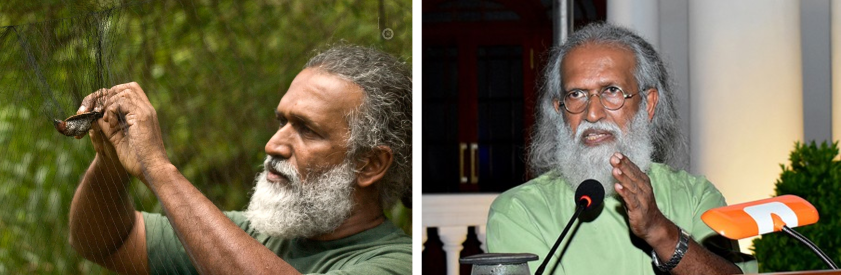
Professor Kotagama has been closely associated with the Sinharaja Rainforest since the 1960s. © Kotagama
How has the protection of the area evolved and how is it managed today?
The Forest Department has long been responsible for the area. Following the logging controversy, Sinharaja was first declared a Biosphere Reserve and then a World Heritage Site in 1988. The National Conservation Review of the early 1990s further strengthened the nationwide protection of natural forests. Since then, commercial logging of natural forests has ceased, and timber production relies on plantations.
The Forest Department continues to manage the area. One effective measure we advocated for during the World Heritage Site designation is the requirement that guides at each entrance come from the surrounding villages. This promotes local participation and income. There is also a small government research station within the forest, which is used for courses and fieldwork.
What was the exchange with the local communities like when the World Heritage status was being prepared?
Initially, about 22 villages rejected the proposal. The Forest Department asked for our support. We took young people and villagers into the forest, explained the significance of the World Heritage status, and discussed specific issues. We advocated for continued controlled access to certain non-timber products, such as seasonal fruits or rattan along disturbed streams. We also addressed harmful activities like digging in marshy depressions. Hunting pressure is low in Sinharaja. Sri Lankan culture, also influenced by Buddhism, does not have a strong hunting tradition. Over time, the villages recognized the value of the protected status, particularly through their role as local guides who accompany visitors to the forest entrances.
What challenges do we face today?
There are isolated instances of boundary violations, such as individual felled trees or small clearings. Control is good on the western side, less so elsewhere. A major practical problem is access. After too many buses used to overrun the forest, access was restricted. Today, however, the road is in such poor condition that no vehicle can get in. This hinders research and conservation efforts. We don't need major roads, but we do need minimal, safe access.
Another problem is the institutional division of responsibilities. The Forest Department and the Wildlife Department have partially overlapping areas of responsibility, but coordination is not always smooth. Difficulties are also evident in the plantations. Pinus, a non-native pine species introduced to Sri Lanka for afforestation and forestry plantations, proved unsuitable as early as the late 1980s. Nevertheless, Pinus stands are now spreading uncontrollably, for example in the Knuckles area and the grasslands of the Horton Plains. The necessary ecological restoration of these areas has not yet taken place.
Has the forest recovered in the cleared areas?
Yes, the regeneration is strong. Sinharaja is a rare 50-year long-term experiment. We have detailed maps of the logging routes from the 1970s. A renewed survey of vegetation and wildlife along these lines could show how quickly the forest has recovered and what relationships exist today. Some permanent botanical plots exist, but more comprehensive monitoring is lacking. This is mainly due to a lack of personnel and funding.
What do we know about the effects of climate change?
There are model-based claims suggesting that certain areas of Sinharaja are affected by climate change. However, these assessments have not been verified through on-site fieldwork. Models can provide clues, but they do not replace measured data.
To date, long-term climate data from within the Sinharaja forest is lacking. Although an automatic weather station was installed near the research station after the 2004 tsunami, its location was unfavorable and it did not transmit reliable data. To assess actual climate effects, we need reliable measuring stations within the forest and continuous data collection over many years. Impacts are possible, but they must first be measured.
You mentioned that the protected area has been expanded. What has changed?
Shortly before a change of government, approximately 85 surrounding forest areas were added to the World Heritage List. This significantly increased the size of the protected landscape. While this is positive, we have very little data on these additional areas. Baseline surveys along the elevation profile from 300 to 1,700 meters are urgently needed, especially in higher-altitude areas that remain unstudied. Without such data, it will be difficult to defend these areas against future land use claims.
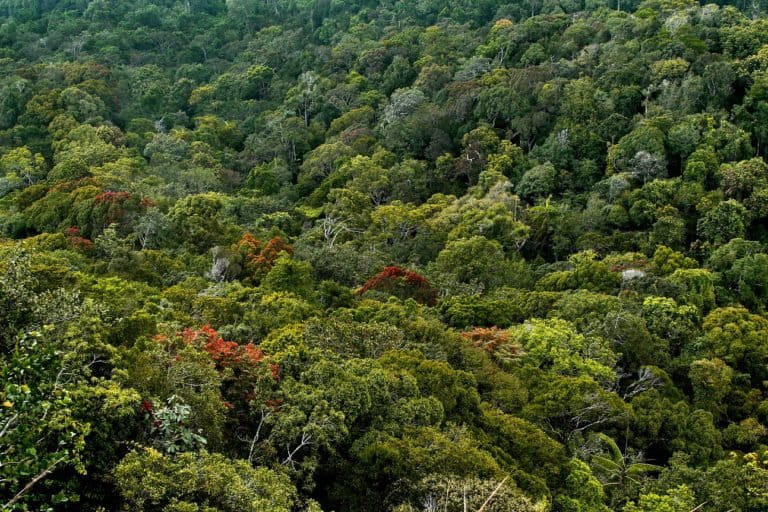
View of the vegetation of the Sinharaja rainforest in southwestern Sri Lanka. © Vimukthi Weeratunga
What is the significance of education and youth programs?
They are central. For decades, we organized programs for schools and young people with the Field Ornithology Group of Sri Lanka and other partners. Unfortunately, COVID and a lack of funding interrupted much of these activities. The 50th anniversary is a good time to resume these activities, perhaps with short stays, guided learning, and direct observation. One must first hear the silence of the forest before understanding the logic of bird communities. This experience instills more appreciation than any theoretical lesson.
If you had to formulate the most important lesson from the story of Sinharaja, what would it be?
Nature conservation should be based on scientific data that is carefully collected and logically analysed. This includes involving local communities. We won the political battle against logging, but a professor told us back then: If protection is to be lasting, you need data. That still holds true today. We must continue to observe, share data, and involve the people who live with the forest. Only in this way will Sinharaja remain what it is: a living natural heritage.
This interview was conducted by Robert Delilkhan.