


Indigenous peoples play a central role in protecting rainforests – while at the same time being themselves threatened by their destruction and the disregard of their rights. On the International Day of the World's Indigenous Peoples celebrated on August 9th, our blog article highlights why protecting indigenous peoples should not be separated from protecting rainforests and the climate.
Indigenous peoples: terminology and population statistics
The term indigenous peoples – originally referring to all descendants of the pre-Columbian populations of the American continents – is now used as a collective term for the original inhabitants of all continents. The term indigenous has also become established as a legal and institutional term. There are now several UN working groups and bodies dedicated to the concerns of indigenous peoples (e.g. the Expert Mechanism on the Rights of Indigenous Peoples, the UN Special Rapporteur on the Rights of Indigenous Peoples, and the Permanent Forum on Indigenous Issues).
Most estimates assume that approximately 4 percent of the world's population can be considered indigenous. [1, 2] Of these, around 50 million indigenous people live exclusively in rainforests and depend directly on these ecosystems. [3] Indigenous peoples who are strongly to very strongly dependent on rainforests live, among other places, in New Guinea (which has the highest density of indigenous peoples in the world), the Amazon region, the Congo Basin including the coast of West Africa, and Southeast Asia/Indonesia. [4]
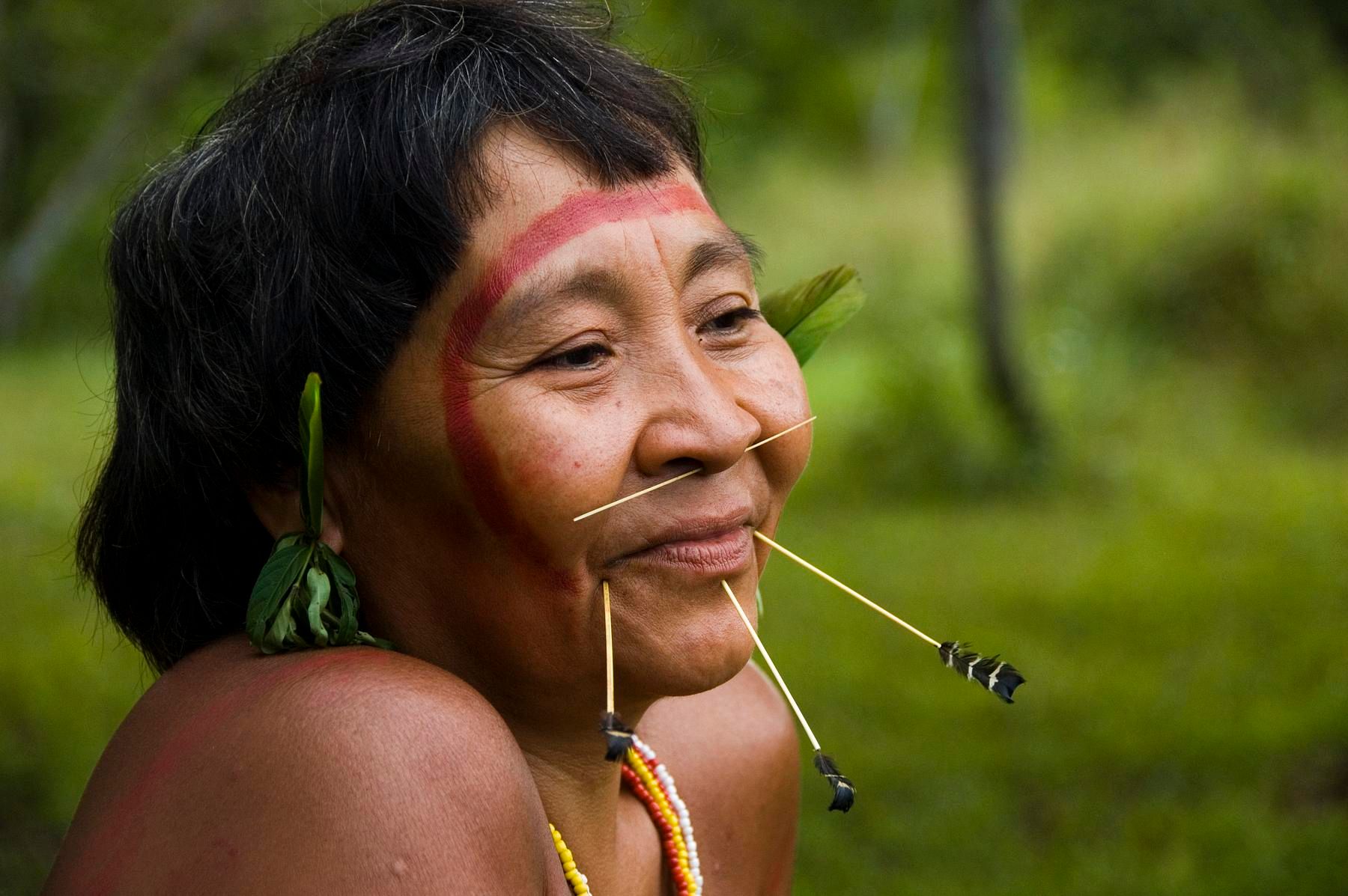
The Yanomami are the largest relatively isolated indigenous people in South America. They live in the rainforests and mountains of northern Brazil and southern Venezuela. © Survival International
Rights of indigenous peoples
The right of indigenous people to work, education, land and social security was first mentioned in 1957 in the Indigenous and Tribal Populations Convention. However, this was not based on any serious intention to preserve indigenous peoples or their cultures and traditions. The majority of states viewed this convention as a transitional arrangement, intended to cover a period during which indigenous populations would become fully assimilated (in sociology, assimilation refers to the process by which one social group becomes integrated into another at the expense of its own culture). [5]
This began to change in the 1970s in the context of emerging civil rights movements. The ILO Convention 169 was subsequently adopted in 1989 and remains the world's only legally binding international agreement specifically protecting the rights of indigenous and tribal peoples. [5] However, as of 2025, only 24 countries worldwide have officially ratified the convention. Switzerland is not among them, although Swiss companies with global operations are also active in countries with indigenous territories. [6] The ILO Convention was supplemented in 2007 by the non-binding UN Declaration on the Rights of Indigenous Peoples. [1]
The ILO Convention and the UN Declaration can be regarded as important milestones for the collective rights of indigenous peoples. These include territorial rights (land and resources), the right to self-determination, the right to participation and protection (against discrimination and threats to territorial integrity), and respect for traditional customs. [1, 6] Another central element is self-identification, meaning that peoples should only be designated as indigenous if they themselves claim this status. [5]
Various national constitutions have also since incorporated provisions establishing and protecting the rights of indigenous peoples.
Why protect Indigenous peoples?
Threats to indigenous communities
Many indigenous communities remain heavily marginalised and receive little support from their governments. To this day, the situation of indigenous peoples is often characterised by difficulties in enforcing and exercising their rights and claims. For example, indigenous land rights are frequently disregarded by expanding agricultural operations or mining and infrastructure projects, which thereby also engage in active “land grabbing”. This is compounded by illegal logging in indigenous territories, the unpunished intrusion of poachers into protected areas, and the killing of both indigenous and non-indigenous activists, whose cases subsequently remain unresolved through the legal system. [1]
Because indigenous peoples depend directly on rainforest resources for their existence, damage to or destruction of these ecosystems fundamentally threatens their livelihoods. In addition to the disregard of their rights, this pressure is intensified by climate change, whose extreme weather events are further exacerbated by forest loss. [4]
Indigenous peoples as guardians of the rainforest
The presence of strong indigenous communities is also crucial from the perspective of rainforest conservation. Various studies confirm that:
- Deforestation rates are often lower in indigenous territories than in government-protected areas. One study estimated the loss of intact rainforest between 2000 and 2016 at 4.9% in indigenous territories, compared with a loss of 11.2% of intact rainforest in non-indigenous areas over the same period. Protecting indigenous peoples and their territories therefore generally protects rainforests to the same extent as, and in some cases even better than, government-established and officially managed protected areas. [7, 8, 9]
- On average, rainforests in indigenous territories are better carbon sinks. [7, 10]
- Biodiversity is often particularly high in indigenous territories. For example, a previous study found that several indigenous territories investigated in Brazil contained more species than government-controlled protected areas. [7, 11]
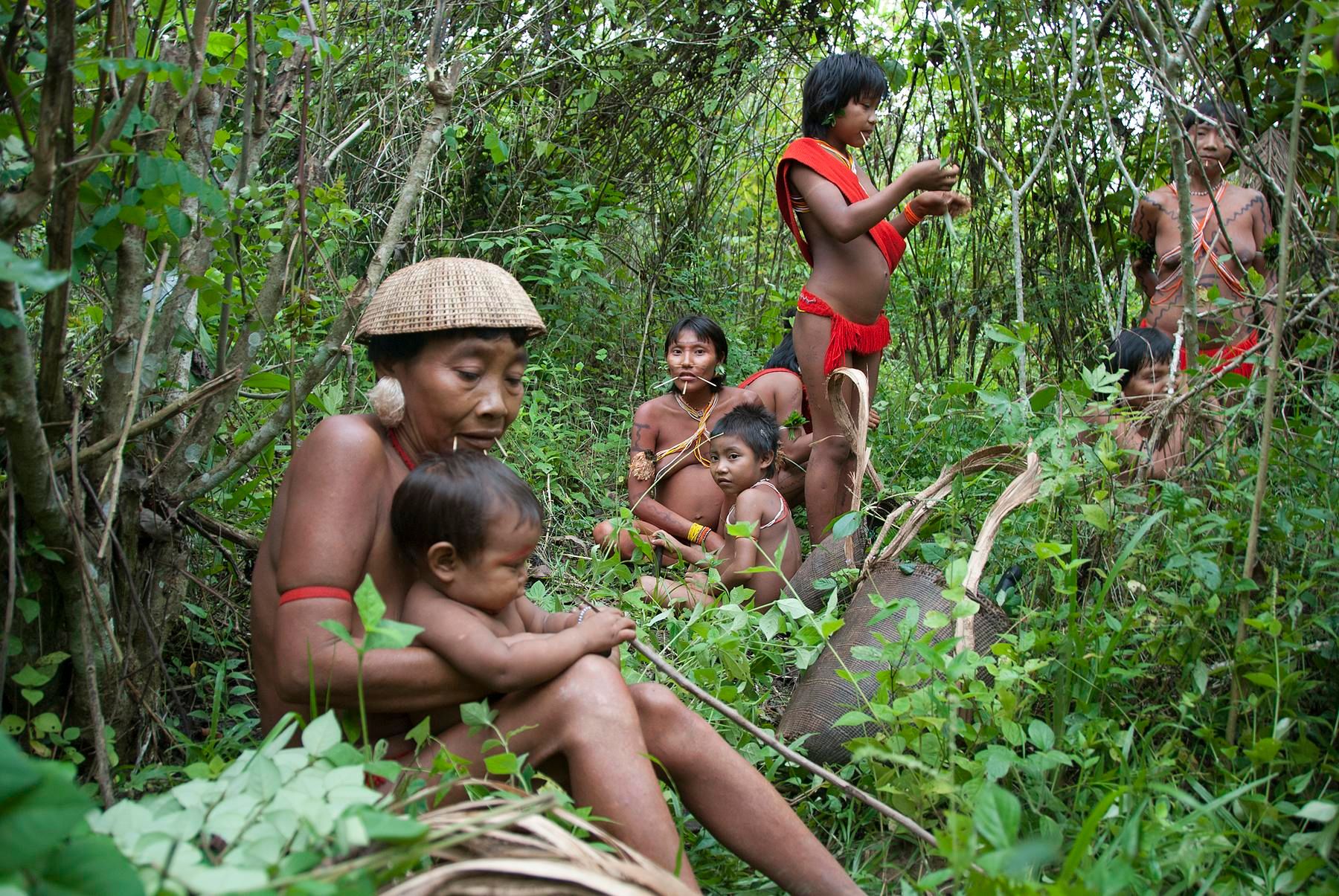
Yanomami women and children collecting leaves that they process into timbó, a substance they use for fishing. © Survival International
Our position
GREEN BOOTS calls for the collective rights of indigenous peoples and local communities to their traditional lands and the resources they contain to finally be recognised for what they are: a fundamental human right. Their relationship with nature is not a marginal issue, but a global environmental service, and the management of their territories should be placed in their own hands. Their work deserves not only recognition, but also political protection and financial support.
That is why, in our projects, we work directly with indigenous partners: to protect their rights, to protect the rainforest, and to protect the climate.
More about our projects with indigenous communities
References
[1] NMRZ. 2018. Indigenen Völker und Ihre Rechte - Zur aktuellen Situation der indigenen Völker in Lateinamerika
[2] https://www.ipacc.org.za, aufgerufen am 06.08.2026
[3] https://www.earthday.org/honoring-indigenous-peoples-and-local-communities-on-world-rainforest-day/, aufgerufen am 06.08.2026
[4] https://www.regenwald-schuetzen.org/regenwald-wissen/regenwaldschutz/was-sind-indigene-voelker, aufgerufen am 06.08.2026
[5] https://www.amnesty.ch/de/magazin-amnesty/2022/2022-3/am-anfang-war-das-land, aufgerufen am 06.08.2026
[6] Wikipedia, aufgerufen am 06.08.2026
[7] FAO and FILAC. 2021. Forest governance by indigenous and tribal peoples. An opportunity for climate action in Latin America and the Caribbean. Santiago. FAO. https://doi.org/10.4060/cb2953en, aufgerufen am 06.08.2026
[8) L. Porter-Bolland et. al. (2012): Community managed forests and forest protected areas: An assessment of their conservation effectiveness across the tropics, Forest Ecology and Management, Volume 268, 2012, Pages 6-17, ISSN 0378-1127, https://doi.org/10.1016/j.foreco.2011.05.034, aufgerufen am 06.08.2026
[9] Julia E Fa et. al. (2020): Importance of Indigenous Peoples’ lands for the conservation of Intact Forest Landscapes Front Ecol Environ 2020; 18(3): 135–140, doi:10.1002/fee.2148, aufgerufen am 06.08.2026
[10] W.S. Walker et. al. (2020): The role of forest conversion, degradation, and disturbance in the carbon dynamics of Amazon indigenous territories and protected areas, Proc. Natl. Acad. Sci. U.S.A. 117 (6) 3015-3025, https://doi.org/10.1073/pnas.1913321117, aufgerufen am 06.08.2026
[11] R. Schuster et. al. (2019): Vertebrate biodiversity on indigenous-managed lands in Australia, Brazil, and Canada equals that in protected areas, Environmental Science & Policy, Volume 101, 2019, Pages 1-6, ISSN 1462-9011, https://doi.org/10.1016/j.envsci.2019.07.002, aufgerufen am 06.08.2026